The best apartment balcony privacy ideas are removable, wind-conscious, and compatible with your lease, railing, drainage, and fire-safety rules. Outdoor curtains, freestanding screens, privacy mesh, trellises, and container plants can all work, but the safest solution is one that does not overload or permanently alter the balcony.
Privacy Priorities: Check building rules first, preserve required exits and drainage, avoid attaching heavy items to railings without approval, choose materials that can handle the local wind and weather, and use planters or screens only where their weight and placement are safe.
Check the lease and building rules before buying anything
Balconies look like private outdoor rooms, but they are part of a larger building. Lease terms, condominium rules, homeowners association requirements, fire codes, building codes, facade standards, and local ordinances may restrict what can be attached to railings or walls, what materials are allowed, and whether screens can extend above the guard.
Ask specifically about drilling, zip ties, clamps, privacy mesh, hanging planters, artificial foliage, outdoor curtains, floor coverings, and freestanding panels. A rule that permits furniture does not necessarily permit an attached privacy screen.
Also keep doors, rescue openings, drains, and required paths clear. Do not create a decorative wall that interferes with emergency access or makes it harder to inspect the railing.
Privacy mesh is simple when the building permits it
Balcony privacy mesh or fabric can reduce direct sight lines through open railings with minimal floor-space loss. It is one of the simplest options for a small balcony, especially when you want screening at seated height rather than a full-height enclosure.
The main issue is wind. A tightly stretched fabric panel acts like a sail, transferring load to attachment points and the railing. Use only attachment methods approved by the building or product manufacturer, and remove the screen when severe weather is expected if required.
Choose outdoor-rated material that drains and dries. A solid, non-breathable sheet can trap moisture, flap loudly, or place greater wind load on the railing. Do not cover the railing in a way that hides corrosion, loose fasteners, or other safety defects from view.
Freestanding screens avoid permanent attachment
A folding outdoor screen or weighted privacy panel can be renter-friendly because it does not require drilling into walls or guardrails. It also gives you flexibility to move the screen as the sun angle, seating arrangement, or season changes.
Freestanding does not mean windproof. A tall panel has leverage and can tip or blow over. Use a product designed for outdoor exposure and follow its base-weight or anchoring instructions. If the building prohibits anchoring, a lower, more open screen may be safer than a tall solid panel.
Position the screen so it does not narrow the exit path or create a climbing aid next to a railing in homes with children. The U.S. Consumer Product Safety Commission recommends window guards and safety netting to help prevent falls from windows, balconies, decks, and landings and notes that ordinary window screens are not fall protection.
Outdoor curtains create flexible privacy
Curtains can provide adjustable privacy and shade when the balcony has an approved overhead structure or tension system designed for the load. They work best where you can pull them open during strong winds and secure them so they do not whip into railings, doors, or neighboring spaces.
Outdoor fabrics should tolerate moisture and ultraviolet exposure, but even outdoor fabric needs drying and cleaning. Avoid letting curtains sit wet against walls or remain bunched in a damp corner where mildew or staining can develop.
Use tiebacks or tracks that are compatible with the lease and building rules. Do not install a rod by drilling into exterior walls, soffits, or waterproofing membranes without written permission and an appropriate installation method.
Trellises add structure without creating a solid wall
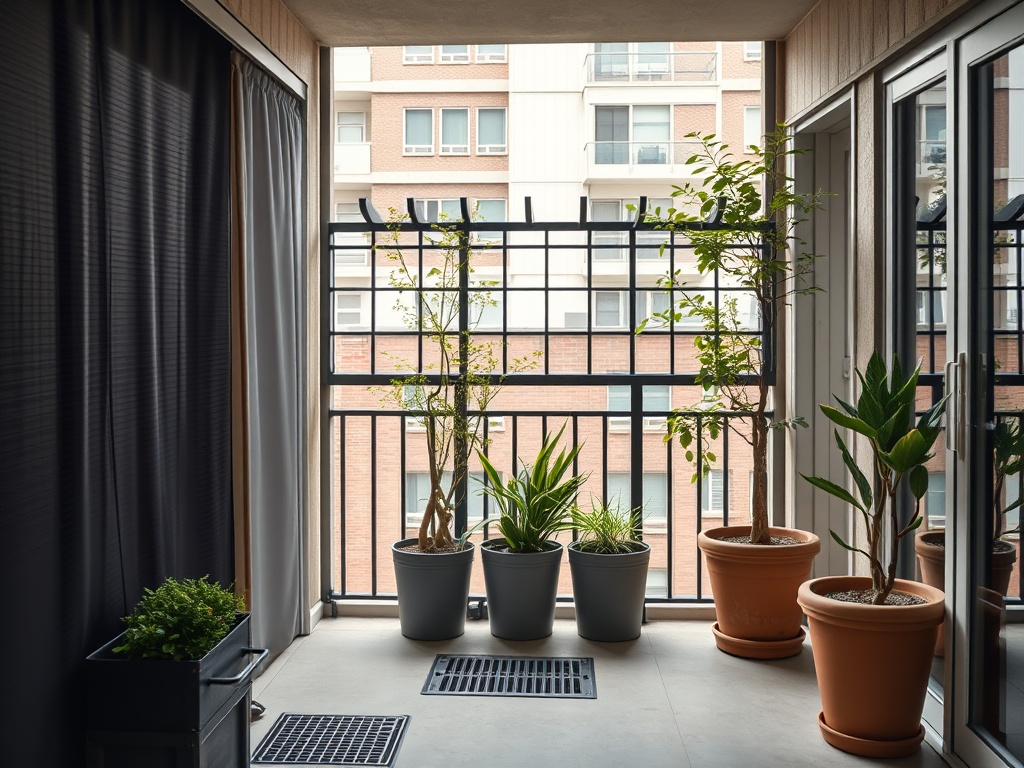
A freestanding trellis can interrupt views while allowing more airflow than a solid screen. It can work alone or support suitable container plants. Choose a base wide and heavy enough for the height, and consider an open pattern in windy locations.
Do not assume that attaching a trellis to the balcony railing is harmless. Railings are safety systems, and added wind load or improvised fasteners can be a problem. Keep attachments within building rules and manufacturer guidance.
A trellis also changes the space visually. Wood can make a balcony feel warmer, while dark metal can recede behind foliage. Those are aesthetic preferences, not performance facts, so choose the material based on the look, maintenance, and weather exposure you prefer.
Container plants provide softer screening
Tall grasses, compact shrubs, bamboo alternatives, vines on freestanding supports, and mixed planters can create partial privacy while making the balcony feel more like a garden. Plant choice must match light, wind, temperature, container volume, and local climate.
Penn State Extension notes that container gardening in small spaces such as patios and balconies depends heavily on the light and temperature conditions of the site. Its container guidance also emphasizes drainage, suitable potting media, and matching plant needs to the location.
For a windy balcony, heavier pots can be more stable, but weight is not unlimited. Wet soil is heavier than dry soil, and large planters add a concentrated load. If you do not know the balcony’s allowable loading or the building restricts heavy planters, ask management or a qualified professional before creating a row of large containers.
Use plant placement to screen the view you actually have
You may not need a full green wall. Sit in the chair you use most and identify the specific sight line you want to block. One tall planter placed strategically may provide more privacy than five small pots spread along the railing.
Layer heights rather than making one solid barrier. A tall upright plant, medium filler, and lower trailing plant can create depth while preserving airflow. In very small spaces, a narrow rectangular planter may use floor area more efficiently than several round pots.
Keep foliage away from exterior vents, lights, sprinkler heads, drains, and mechanical equipment. Do not let climbing plants attach themselves to building surfaces unless that is specifically allowed.
Choose privacy ideas by budget and flexibility
| Option | Best for | Maintenance | Renter flexibility |
|---|---|---|---|
| Privacy mesh | Seated-height screening with little floor-space loss | Wash and inspect fasteners | High if attachment is approved |
| Freestanding screen | Adjustable visual block | Clean, inspect base and hinges | High |
| Outdoor curtains | Flexible open-or-closed privacy | Wash and dry fabric; secure in wind | Medium to high depending on mounting |
| Trellis | Airy screening and plant support | Inspect material and base | High when freestanding |
| Container plants | Soft partial screening and greenery | Watering, feeding, pruning, seasonal care | High but weight must be considered |
Make the balcony easier to use, not just harder to see
Privacy works best when it improves comfort without shrinking circulation. Leave enough room to open the door fully, move a chair, access the railing for inspection, and reach drains. Avoid filling the perimeter so densely that cleaning becomes difficult.
If the balcony surface is visible from the living room, coordinate materials without forcing an exact match. The ideas in the truth about matching furniture sets apply here too: repeat a few colors or materials and allow variation.
Clutter also reduces usable space. Before adding a screen, remove items that do not belong outdoors and give watering tools, cushions, and small accessories a defined place. The principles behind countertop appliance storage that reduces clutter translate well to a balcony: store by frequency and do not hide frequently used items so deeply that the system becomes annoying.