The best countertop appliance storage plan keeps high-use equipment easy to reach, moves occasional-use items out of the main work zone, and gives every appliance a safe place to cool, plug in, and be cleaned. The goal is not an empty counter at any cost; it is a kitchen where the appliances you actually use do not compete with prep space.
Storage Shortlist: Keep daily appliances in a dedicated counter zone, place weekly items on easy-access shelves or pull-outs, store bulky occasional appliances lower or farther away, and avoid enclosed storage that conflicts with ventilation, heat, cord, or clearance requirements in the appliance manual.
Begin with frequency rather than appearance
Take every small appliance you regularly use and sort it into three groups: daily, weekly, and occasional. A coffee maker used every morning deserves different access than a stand mixer used twice a month. This simple frequency audit prevents a common mistake, hiding a daily appliance in an inconvenient cabinet only because an uncluttered counter looked good for a day.
Next, identify the appliance’s working footprint, not just its storage footprint. A toaster needs room for safe operation and crumb removal. A blender needs vertical clearance to remove the jar. A stand mixer may need space for the head to tilt or bowl to lift. A pressure cooker or multicooker may have steam-clearance instructions. Measure those needs before assigning a cabinet.
Finally, consider the path between storage and use. Heavy appliances are easier to manage when they can slide forward or lift a short distance rather than travel across the room from a high shelf.
Create a deliberate everyday appliance zone
A controlled counter zone is often better than forcing every appliance behind a door. Choose a section near appropriate outlets and group the equipment you use most. A tray can visually contain a coffee setup, while a shallow mat can protect a surface if the manufacturer allows it and does not block ventilation.
Leave enough prep space elsewhere. If appliances occupy every stretch of counter, move the least-used pieces first rather than compressing everything into a tight row. Avoid placing heat-producing appliances directly under materials or cabinets when the manufacturer’s instructions call for clearance.
Electrical safety should influence the zone. The U.S. Fire Administration advises checking appliance cords for damage and cautions against unsafe extension-cord use for cooking equipment. Its cooking fire-safety guidance is a useful reminder that storage convenience should not create improvised electrical arrangements.
Use appliance garages carefully
An appliance garage can hide a toaster, coffee maker, blender, or similar item behind a lift-up, pocket, tambour, or retracting door. It can be an excellent visual solution when the appliance remains on the counter and the door disappears while the equipment is in use.
The key issue is whether the appliance can safely operate in the space. Heat, steam, and airflow requirements vary. Do not assume an enclosed cabinet is suitable just because the appliance fits. Read the manual for required clearances and ventilation, and operate heat-producing appliances only in the manner the manufacturer permits.
Plan the door hardware so it cannot swing into the appliance or block a work aisle. If outlets are inside the cabinet, electrical work and receptacle placement need to comply with local code. A cabinetmaker can design the enclosure, but an electrician may be needed for power changes.
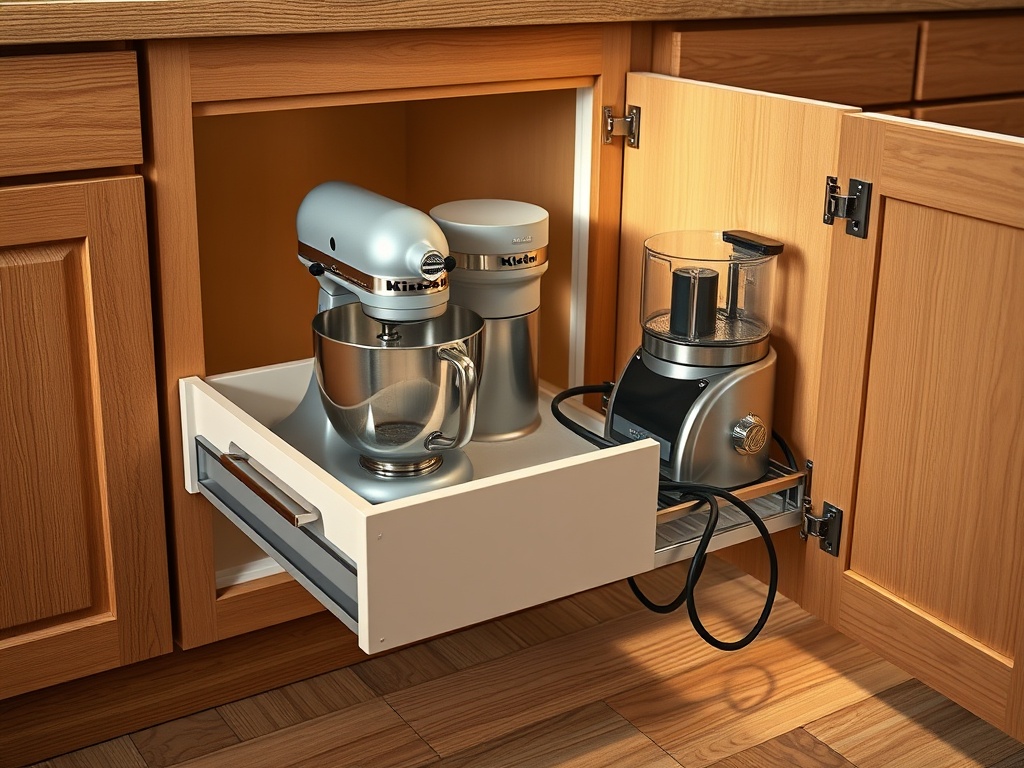
Add pull-out trays for heavy countertop equipment
A sturdy pull-out shelf can make a mixer, food processor, or bread machine easier to access. The advantage is not that the appliance disappears; it is that you can bring it into a usable position without reaching deep into a cabinet.
Check the rated load of the hardware and the combined weight of the shelf and appliance. Heavy equipment can put substantial leverage on slides when fully extended. The cabinet box and fasteners also need to support the load.
Avoid narrow pull-outs that force cords to bend sharply or leave the appliance unstable. If the equipment must be moved to a counter before use, design the shelf around safe lifting height and a clear transfer path.
Keep cords from becoming the hidden clutter
Cords often create more visual noise than the appliance itself. Use the appliance’s built-in cord wrap if it has one, or loosely secure the cord during storage without tight bends that may damage it. Do not coil a hot cord against a hot appliance.
Avoid relying on extension cords as a permanent layout solution. CPSC explains that extension cords must be appropriate for the electrical load and designed with required safety characteristics. For a kitchen that regularly needs more outlets in the right places, a qualified electrician can assess permanent receptacle options under local code.
Inspect cords as you clean. Cracking, exposed conductors, damaged plugs, or unusual heating are reasons to stop using the appliance and follow manufacturer or professional guidance.
Build cleaning access into the storage plan
A storage idea fails if it makes crumbs, grease, or spills impossible to reach. Leave room to remove trays and wipe behind equipment. For appliances with crumb trays, reservoirs, filters, or removable parts, the storage location should not make those maintenance tasks so awkward that they are skipped.
The U.S. Fire Administration specifically warns that crumbs in a toaster or grease on cooking equipment can contribute to fire risk. Cleaning is not only cosmetic. It is part of appliance care.
When choosing products for the surrounding counter, do not assume stronger is better. These cleaning product myths that don’t hold up explain why surface compatibility and label directions matter more than aggressive chemistry.
Reduce visual clutter beyond the appliances
Sometimes a counter looks crowded because appliances are competing with mail, supplements, utensil crocks, fruit bowls, chargers, and decorative objects. Before buying specialty cabinetry, remove or relocate the non-kitchen items that do not need to live in the prep zone.
A coordinated room can still include varied storage pieces. If an open kitchen connects to a dining or living area, the principles in the truth about matching furniture sets can help you create visual continuity without making every cabinet, stool, and table identical.
For very small homes, outdoor storage is rarely a safe overflow solution for electrical appliances because heat, moisture, pests, and lease rules can create problems. If the balcony itself needs better organization or screening, use these apartment balcony privacy ideas rather than shifting indoor clutter outside.
Set up a kitchen you can maintain
Choose one improvement at a time. Move the most rarely used appliance off the counter, create one daily-use zone, and test the new arrangement for a week. If you constantly retrieve an item from a difficult location, promote it to a more accessible shelf. If something never moves, it may not deserve prime storage.
The best countertop appliance storage is specific to your cooking habits, physical comfort, cabinetry, and electrical layout. A kitchen with two visible appliances that are used every day can be more functional and less cluttered than a supposedly empty counter supported by inconvenient storage.
Use the appliance manuals as the final authority on operating clearances, ventilation, heat, steam, and electrical requirements. Then design the storage around those constraints, not the other way around.
This article is for general educational purposes. Follow appliance and cabinet manufacturer instructions and use qualified electrical or remodeling professionals where required.