Matching furniture sets are not inherently outdated or wrong. They can create order and make shopping easier, but a room often feels more personal when pieces relate through scale, color, material, shape, or era without being identical. The best choice depends on the room, the people using it, and the look you want.
Design Reality: A coordinated room does not require identical furniture. Repetition creates connection, while variation creates depth. A matched set can still work when you introduce contrast through lighting, textiles, art, side tables, rugs, or one deliberately different furniture piece.
Why the “never buy a matching set” rule became popular
Matching suites solve a real problem: they remove uncertainty. A bed, nightstand, and dresser from one collection share finish, hardware, proportions, and design language. In a living room, a sofa and chair sold together can reduce the chance of clashing shapes or fabric colors.
The criticism appears when every large item repeats the same finish and details so closely that the room feels like a showroom display rather than a home assembled over time. That reaction is a design preference, not an objective defect. Some people genuinely prefer visual uniformity, and a highly coordinated set may be the right choice for them.
Professional design trends also move in cycles. The American Society of Interior Designers has highlighted mixing styles, vintage pieces, craftsmanship, and personal narratives as part of recent design direction. That supports a broader preference for collected interiors, but it does not turn matched furniture into a design mistake.
Coordination is a relationship, not an exact match
A room looks coherent when the eye can find repeated visual cues. Those cues might be warm wood undertones, black metal accents, rounded corners, low horizontal profiles, woven textures, or a limited color palette. Two pieces can be completely different brands and still feel related because they share one or two of those qualities.
At the same time, too much repetition can flatten the room. If the coffee table, console, side tables, dining table, and shelving all use the same wood stain, same leg shape, and same hardware, nothing has a chance to become a focal point. Contrast helps the eye understand hierarchy.
The useful question is: what should repeat, and what should vary? Try repeating two or three elements and varying the rest. For example, keep warm oak tones and soft curves consistent while changing upholstery, table bases, and surface materials.
Scale matters more than a perfect finish match
A beautiful mixed room can still feel wrong if the furniture is poorly scaled. A deep sectional can overwhelm a narrow living room. A tiny coffee table can look stranded in front of a large sofa. Tall bedside chests can feel awkward next to a low platform bed even when the wood finish matches perfectly.
Before choosing style, measure circulation paths, door swings, window access, and how people actually move through the room. Think about seat height, table height, reach, and visual weight. These are functional relationships, not just aesthetic ones.
Universal design offers a useful reminder that rooms should work for real bodies and different abilities. AARP describes universal design in housing as an approach that makes spaces usable by a wider range of people. You do not need to redesign a home around accessibility to benefit from the principle that furniture arrangement should support comfortable movement.
When a matching set is the practical choice
A matching set can be especially useful when you need to furnish a room quickly, want a calm and symmetrical look, or feel overwhelmed by comparing finishes. It can also make sense in a compact bedroom where visual simplicity is more valuable than layered contrast.
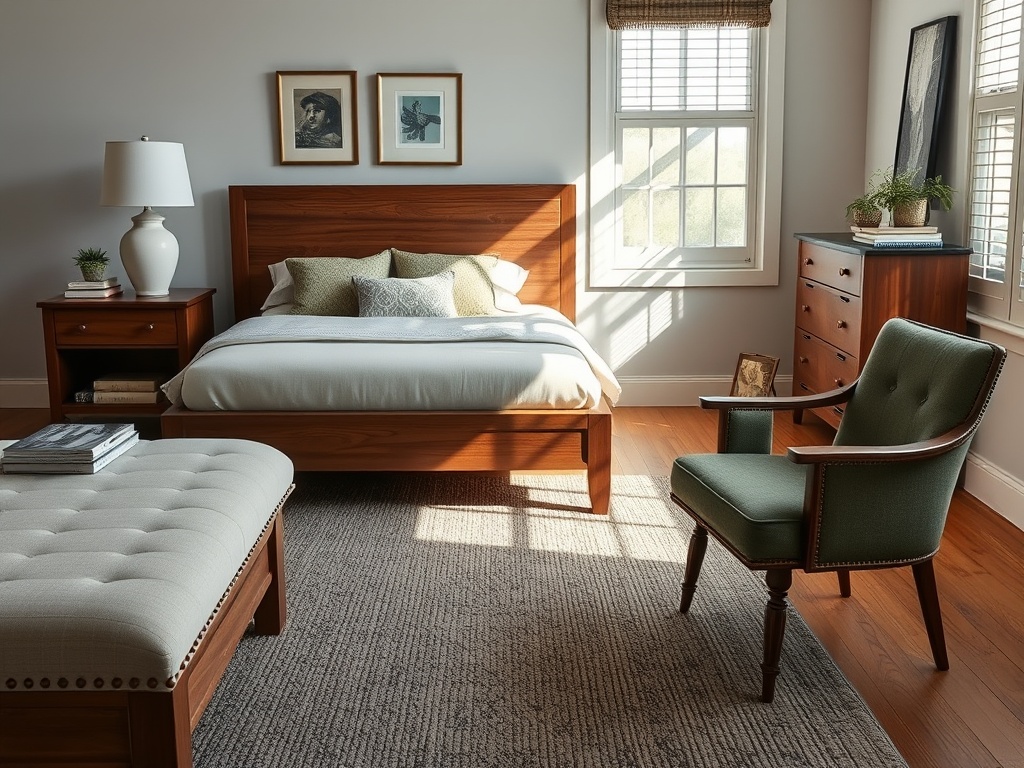
The key is to avoid letting the set make every remaining decision. If you buy a matching bed, dresser, and nightstand, you can still introduce a different bench, lamp finish, rug texture, or upholstered chair. A consistent base with flexible accessories is easier to refresh later.
Matching can also be useful when replacement availability matters. If you know you may add a second nightstand or another dining chair soon, buying from an active collection can simplify the process. That is a practical purchasing advantage, not a design rule.
When mixing pieces creates a stronger room
Mixing works well when the architecture already has character, when you own meaningful furniture, or when you want the room to feel collected rather than installed all at once. The method is not random. Strong mixed rooms usually have a visible organizing idea.
One approach is to choose a dominant material and one contrast. A walnut dining table can sit with upholstered chairs on black frames. Another is to repeat shape: a curved sofa can relate to a round side table even if the materials differ. A third is to connect pieces through color so a vintage cabinet and modern chair share a common warm or cool undertone.
Age can also be a connector. A new sofa beside an antique chest works when the contrast feels intentional and another element repeats the antique’s warmth or texture. Without that bridge, the older piece may look isolated.
How to break up a set you already own
You do not need to replace a full furniture suite to make the room feel less matched. Start with the easiest movable element. Swap one side table, change lamps, add an upholstered bench, repaint a small accent piece if its construction allows, or move one matching item to another room.
Textiles can do substantial work. A rug introduces a different material and pattern under matching wood pieces. Drapery changes the vertical rhythm. Pillows and throws can connect a new accent color to existing furniture without refinishing anything.
Lighting is another useful break. If every furniture piece is dark wood, a ceramic lamp, brass floor lamp, or paper shade can interrupt the repetition. Art and objects add personal references that make a matched foundation feel less catalog-like.
If the room feels visually busy for another reason, furniture may not be the real problem. These countertop appliance storage ideas that reduce clutter show how visible objects and storage patterns can influence the sense of order in adjacent living spaces.
A better rule: match on purpose and mix on purpose
Ignore the claim that a matching set automatically makes a room look dated. It can look calm, formal, simple, or convenient. Likewise, mixed furniture is not automatically sophisticated; without a connecting idea, it can feel disjointed.
Choose a few anchors, such as a consistent color temperature, repeated shapes, compatible scale, or one shared material. Then allow enough contrast for the room to have hierarchy and personality. That framework is more flexible than trying to follow a trend rule.
If you are furnishing from scratch, buy the hardest piece first, often the sofa, bed, or dining table, and build around it slowly. If you already own a set, change the room in layers rather than replacing useful furniture simply to avoid a label. A room that functions well and reflects the household is a stronger goal than proving that no two pieces match.
For care decisions across mixed finishes, revisit these cleaning product myths. If the room opens to a small outdoor space, these balcony privacy ideas for apartments can help carry a few visual cues outside without creating a rigid matched look.
Interior-design guidance includes subjective preferences. Safety, accessibility, anchoring, clearances, and structural decisions may require manufacturer instructions or professional advice.[/